
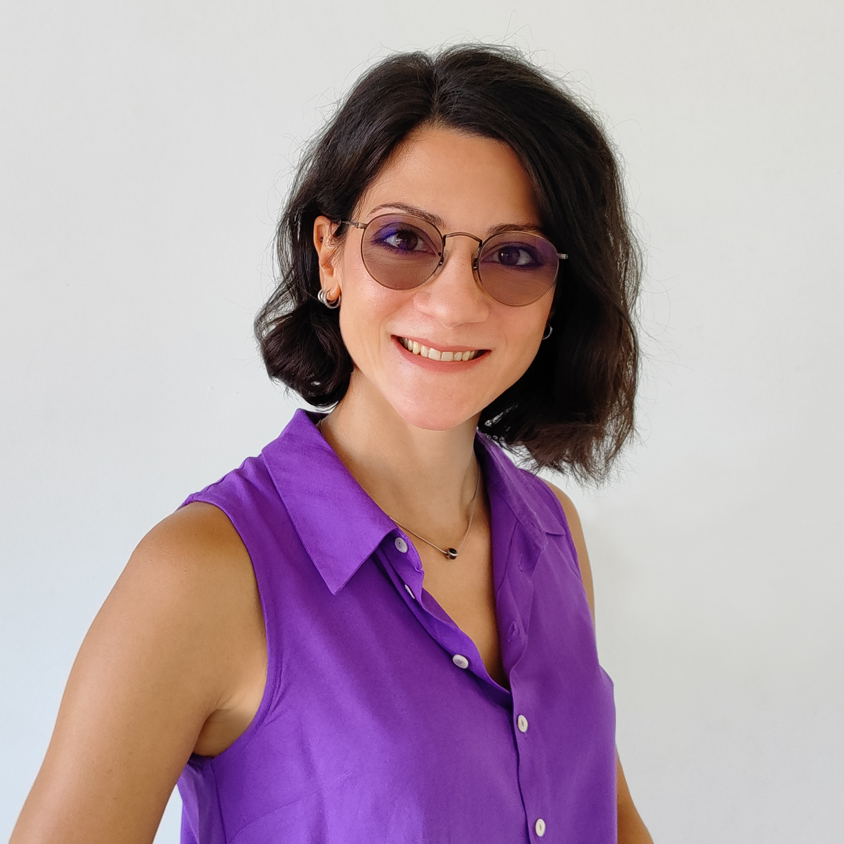
This is where I am
I go deep, asking the questions most avoid.
I’m Anastasia Tsita and as a product-oriented UI/UX designer, I help teams reduce reworks with strategic design that can withstand and adapt to structural changes, scaling and rebranding.
I aim for systems that can last through their intended purpose, while reducing future design and development costs and time.
From product strategy to detailed design, I focus on what matters, clarify needs and definitions, and bring order to chaos so you can focus on your vision.
My thinking is shaped by inclusive design principles, as well as cognitive and behavioral learning psychology. I take a holistic approach, applying systems-thinking alongside design-thinking to understand how solutions can exist within larger contexts.
Over the past seven years, I’ve worked across both research and commercial work, helping transform ideas into usable, productized solutions.
Background
As a teenager, my enthusiasm for physics drew me into reasoning and introduced me to the world’s paradoxes, order, and chaos. It taught me how to break down a problem and separate the facts from the questions. I learned that perspective matters, yet there’s always what works and what doesn’t.
I credit my approach to interpreting information, communicating, and creating to my university training in education, which I stumbled into by chance at eighteen.
There, I discovered I was good at designing custom and unique activities, tools, games, and stories. I could design, guide and implement experiences with a beginning, middle, and end, clear goals, documentation, and evaluation checkpoints. At the same time, I learned to stay creative and resourceful: keep to a budget, follow official curricula, respect norms, and keep children, schools and parents happy.
This background is a real advantage for human-centric design. It translates directly to product UI/UX design because, in education, designing intuitive, and even challenging yet fun, experiences is a must for successful play and learning.
In both education and human-computer interaction, the goal is to customize experiences using appropriate materials to address participants’ prior experiences, mental models, individual needs, abilities, and circumstances, all within the relevant values, regulations, and context.
Even though I was good at it, I knew that teaching wasn’t my path. After exploring my options, I eventually shifted to interactive systems and completed my M.Sc. in Design of Interactive and Industrial Products and Systems, initially thinking I would design digital tools for physics education.
Experience
Ultimately, an explorative mindset led me to a technology research institute. For the last seven years, I’ve been contributing as a UI/UX designer, helping to productize digital solutions for both research and commercial projects of the institute and some of its spin-off companies.
I’ve designed or redesigned nearly 80 interfaces or major interface components, contributing across the full process, from discovery to deployment, within fast-paced, cross-functional teams. Despite the large amount, 20 of these have been commercialized, either deployed through clients or launched as spin-off products.
This is where I found myself working on a variety of project sizes and complexities, sectors, technologies, and team setups.
During those years, I evolved from seeing engineers as the only experts – and viewing myself as just an “execution end” – to influencing managerial, business, and technical decisions. I earned the trust of my technical colleagues and an equal seat at the table.
Over time, I realized that because I am comfortable with ambiguity and able to break problems down, I am most useful when working with the complexity of the real world.
I reached a point where I felt that supporting institute research was no longer for me. Honestly, I don’t see a path for professional growth for me within the research domain.
My mindset shifted. I wanted to work in the market, and I decided that I can do my own research on the things that matter to me, regardless of my occupation.
As a long-term project came to completion, I quit my position after six and a half years, in June 2025. Over the following four months, I mainly kicked off the design process for a new long-term project, led the delivery of its first design phase, and completed the handover.
The future
I feel blessed to have completed more than a couple of projects as an independent designer, and to now be able to focus on studying and setting up my practice.
Hopefully, by the end of January 2026, I’ll be “hitting the road”, ready for whatever comes next. I am determined to find like-minded people who share similar goals and to understand how I can best serve them.
I’ve done my best to find the words that describe what I want from the next professional chapter of my life.
So this is it. This is my goal:
To enable the independence and growth of individuals so they can reach their potential, and to encourage communities to thrive through freedom and respect. On purpose and with reason.
I aim to do this by asking the right questions, creating meaningful solutions, and delivering value through my product UI/UX design services within the smart home and smart city domains.
Think we could match?
If you’re working on smart home or smart city solutions and looking for a strategic designer who can go deep without losing to complexity and ambiguity, check me out. 👇
👉 Check out my services to see how I can help.
👉 Check out my portfolio to see examples of my work.
👉 Check out what others said about my work.
👉 Do you have questions or any thought to share? Contact me.
👉 If you are ready to talk about your project and your needs, book a free 30’ meeting.
Find me
Drop me an email
anastasia.tsita@gmail.com
© 2026 Anastasia Tsita / Cookie policy / Privacy policy
